
.png)
The 4 Pillars of Growth for Billiard & Snooker Clubs
%201.png)
Cue sports are having a moment.
Nearly 750 million viewers watched snooker on television during the 2024–25 season. China alone generated 1.1 billion live streams — a staggering 68% increase year-over-year. BBC iPlayer recorded 40 million snooker streams, its highest count ever. Prize money across the World Snooker Tour jumped to £18.2 million, up 61.4% in just two seasons. And snooker isn't the only format experiencing this surge — Heyball (Chinese Eight-Ball) is expanding rapidly worldwide, while eight-ball, nine-ball, and ten-ball pool have seen increased tournament participation, sponsorship deals, and televised coverage.
The global appetite for cue sports has never been greater.
Yet many billiard and snooker clubs are not reaping the full benefits of this wave. Player expectations have evolved. Retention is harder than it used to be. Attracting new members requires more than simply opening the doors and hoping for word-of-mouth. Operating costs are rising, and running events manually — through group chats, spreadsheets, and phone calls — no longer scales.
The clubs that will thrive in this environment are not necessarily the ones with the best tables or the biggest spaces. They are the ones that operate with intention, backed by structure, data, and the right tools.
This article breaks down the four core pillars that determine whether a cue sport club grows or stagnates — and what club owners can do, starting today, to strengthen each one.
Pillar 1: Building a Solid Player Base
%201.avif)
Growth begins with acquisition. Before you can retain players, you need to bring them through the door — and for many clubs, this is where the first gaps appear.
The most effective player acquisition strategies are not expensive. They are consistent and community-driven.
Partner with local organisations. Schools, universities, community groups, hotels, and resorts are all untapped pipelines. A partnership with a local university to offer student discounts or host a beginner clinic costs little but introduces your club to an entirely new demographic. Hotels and resorts, particularly those catering to longer-stay guests, are often actively looking for curated leisure experiences — cue sports fit that need perfectly.
Run introductory clinics and demonstrations. Free or discounted beginner sessions remove the single biggest barrier to entry: intimidation. Many people are curious about billiards or snooker but assume they need prior experience or skill to show up. A structured, welcoming first experience changes that perception and creates the foundation for long-term membership.
Invest in your digital presence. Your Google Business Profile, website, and social media channels are often the first impression a prospective player will have of your club. Keep your profile updated, respond to reviews, and post consistently about what is happening at your club — events, results, player milestones. Social proof matters. A club that looks active online signals to newcomers that it is worth visiting.
The goal of all acquisition activity is to turn curiosity into a first visit. From there, retention takes over.
Pillar 2: Player Retention Through Events, Rankings, and Structured Play
.avif)
Acquiring a player once is relatively straightforward. Keeping them engaged, motivated, and returning week after week is where most clubs face their real challenge — and where the biggest growth opportunity lies.
The foundation of retention is structured, regular play.
Open Play: The Weekly Anchor
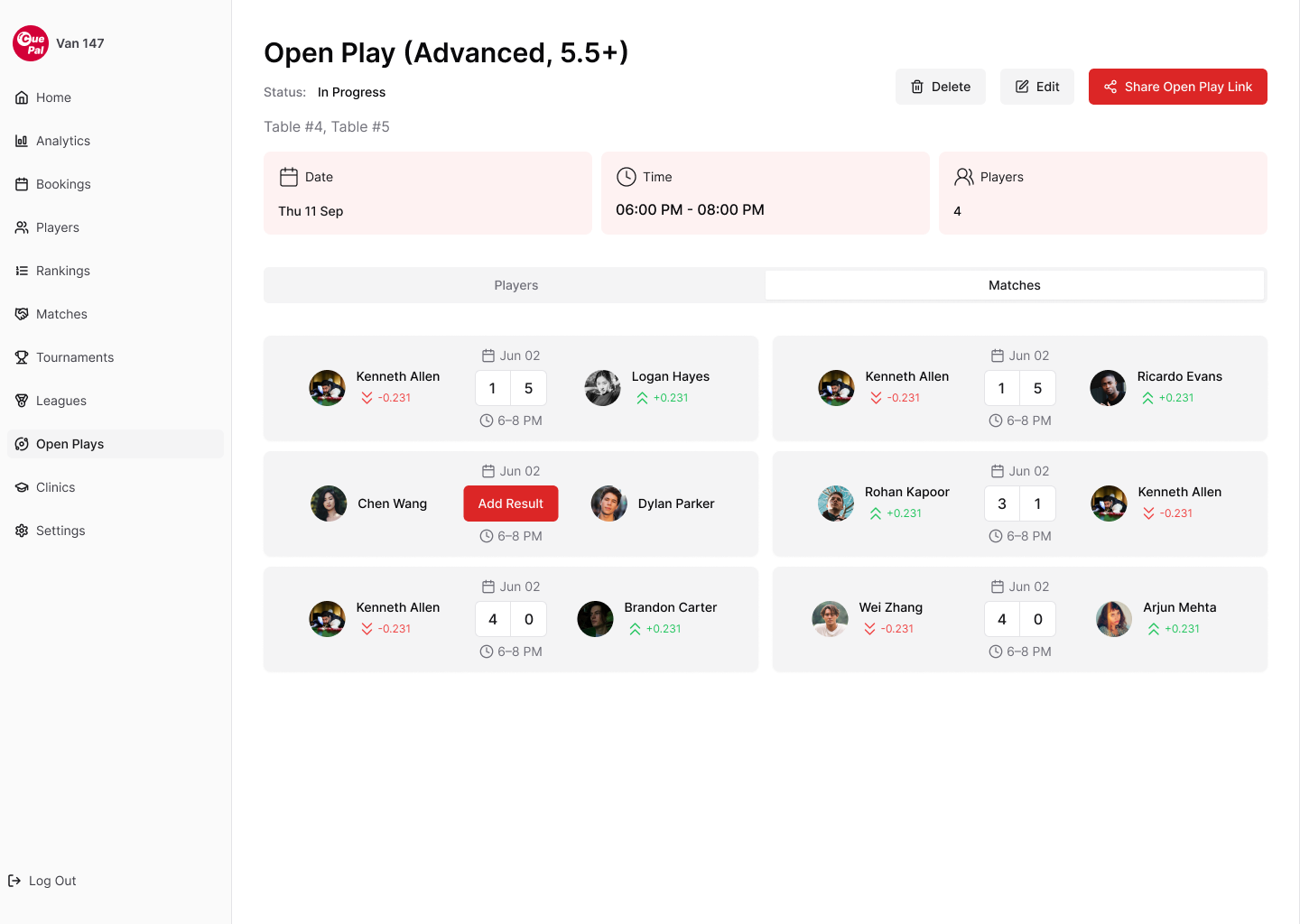
Open play — where players are matched with others at a similar skill level in a rotational format — is the most powerful retention tool available to club operators. It solves a problem that many casual players face: showing up to a club only to find no one to play with, or being consistently outmatched by more experienced regulars.
When open play is skill-matched, structured, and consistent on the calendar, it creates a reliable social and competitive rhythm that players build their weeks around. Tables stay active. The club feels alive. And players feel they belong.
Leagues: Long-Term Commitment and Loyalty
Leagues take engagement a step further. By creating seasons with standings, scheduled match days, and a progression structure, leagues give players a reason to return not just this week — but for the next three months. The commitment is self-reinforcing: once a player is invested in their league standings, absence has a cost they feel personally.
League formats also create community. Rivalries develop. Players follow each other's results. The club becomes a place with a story, not just a venue with tables.
Tournaments: Peak Moments That Drive Growth
.avif)
Tournaments generate the highest single-day energy of any club event. They attract players who might not visit regularly, create social media content opportunities, and — when well-run — become the kind of events players talk about and look forward to.
The format matters. Single-elimination tournaments are fast and dramatic. Double-elimination gives players more matches and a more forgiving structure. Round-robin formats maximise table time and are ideal for smaller groups. Handicap tournaments level the playing field and are particularly effective for mixed-ability clubs. Invitational events create prestige.
Running multiple tournament formats across the year keeps the calendar varied and gives every segment of your player base — competitive, casual, beginner — a reason to participate.
Rankings: Turning Play Into Progression
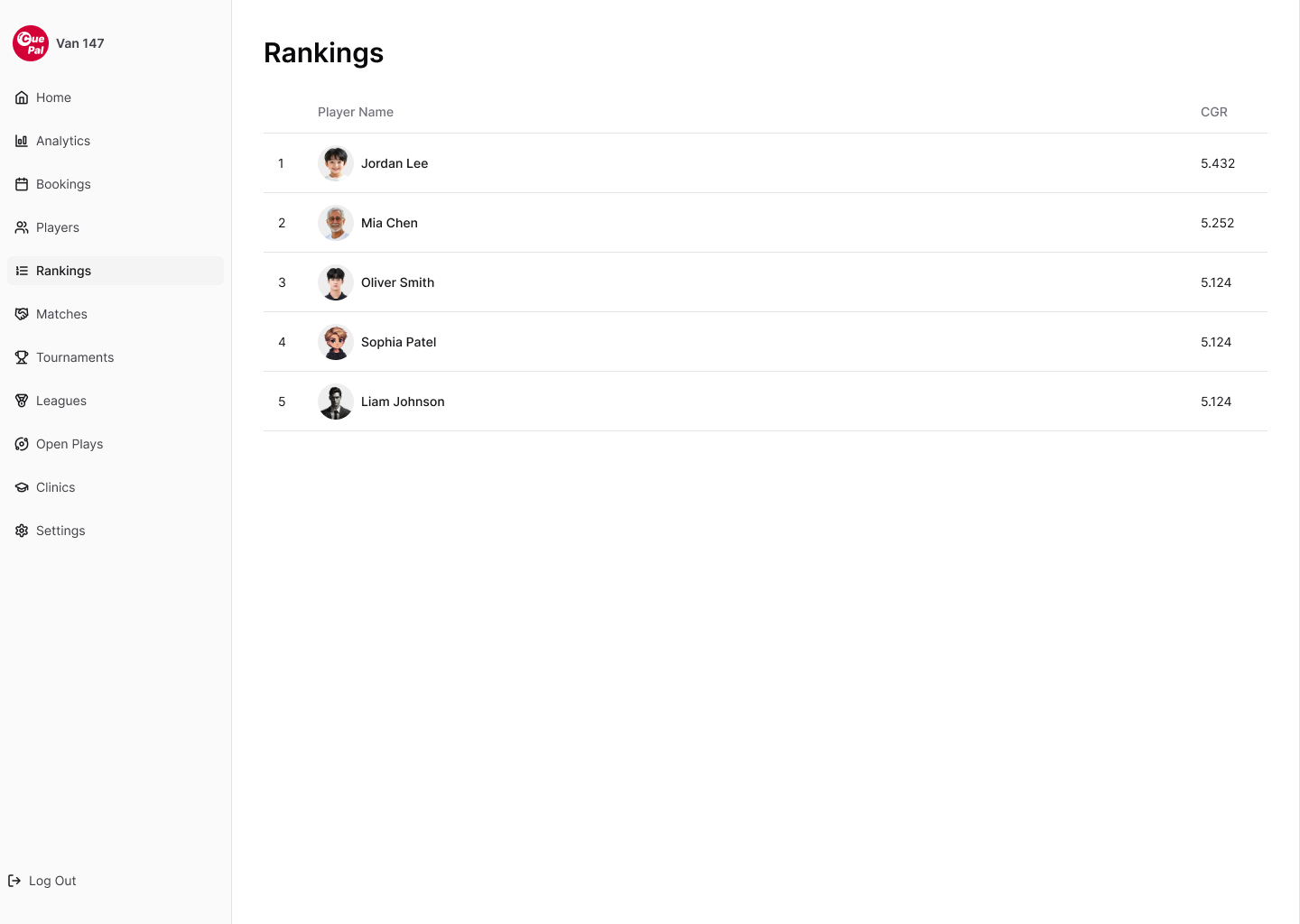
Of all the tools available to club operators, rankings may be the most underutilised. A well-implemented ranking system transforms casual, disconnected matches into a continuous narrative of progression and competition.
Rankings encourage players to participate more frequently because every match has meaning. They create natural rivalries that players care about. They support accurate skill matchmaking, which makes every game more enjoyable. And they give players a long-term goal — something to chase — that pure recreation cannot provide.
For many players, watching their ranking climb is as motivating as any prize. It is a measure of growth, and growth is what keeps people engaged.
Pillar 3: Operational Efficiency — Running Your Club Smarter
.avif)
Growth brings complexity. More players, more events, more communications, more registrations, more payments. For many club operators, this complexity compounds until it becomes a genuine barrier — not to growth, but to sanity.
The solution is not to work harder. It is to remove friction through automation and centralisation.
Manual processes — managing event sign-ups through WhatsApp, tracking registrations in spreadsheets, chasing payments individually — are not just time-consuming. They are error-prone, inconsistent, and create a poor experience for players who expect the same convenience in their leisure activities that they get everywhere else in their lives.
Clubs that automate scheduling, player registration, payment collection, and communications can reduce manual administrative work by 30–40%. That time goes back into what actually matters: being present on the floor, engaging with players, and improving the experience.
Simplified registration drives participation. When joining an event takes 30 seconds from a phone, more players join. When it requires a phone call or a message and a wait for confirmation, many simply don't bother. Friction is invisible until you measure it — and when you remove it, the difference in participation rates is immediate.
Centralised communication reduces confusion. Automatic event reminders, clear notifications, and centralised updates mean players always know what is happening and when. Club operators spend less time answering the same questions and more time running a better experience.
Organised player data enables better decisions. When player history, participation records, and contact information live in one place — rather than across multiple apps, spreadsheets, and notebooks — every decision becomes faster and more accurate.
Operational efficiency is not glamorous. But it is the infrastructure that makes everything else in this framework possible at scale.
Pillar 4: Financial Optimisation — Growing Revenue the Smart Way
.avif)
Revenue growth for cue sport clubs does not typically come from raising prices or packing in more tables. It comes from increasing the lifetime value of each player — getting them to visit more frequently, commit more deeply, and find more reasons to spend at your club.
The four primary drivers of revenue in this model are repeat visits, event participation, membership commitment, and long-term engagement. Each pillar in this framework, when executed well, feeds directly into one or more of these drivers.
Membership Programs: Stability and Belonging
Membership programs do two things that transactional revenue cannot: they create predictable income, and they create belonging. A player who pays a monthly or annual membership fee has made a psychological commitment to the club. They are more likely to show up consistently, participate in events, and refer others.
Memberships also smooth out the natural seasonality that affects many clubs. A strong membership base means your revenue does not collapse during slow periods — it remains stable while you build on top of it.
Event Revenue: Beyond the Entry Fee
Events are not just traffic drivers — they are revenue multipliers. A well-structured tournament or league season generates direct income through entry fees and registrations, but it also increases ancillary spending: table time before and after events, food and beverage consumption, merchandise. Players who come for an event often stay longer and spend more than players who drop in casually.
The clubs that treat events as a core revenue strategy — not an occasional bonus — see compounding returns as their event reputation grows.
Using Data to Guide Financial Decisions
Perhaps the most powerful shift a club can make is moving from intuition-based decisions to data-driven ones. Which events consistently fill up? Which time slots perform best? Where are players dropping off in their first 90 days? What is the average number of visits before a player converts to membership?
These questions have answers — but only if you are collecting and tracking the right data. When you can see clearly which events are your highest performers, you can double down on them. When you can identify the point at which players typically churn, you can intervene before it happens. When you know your conversion rates, you can optimise your onboarding process.
Data does not replace instinct. But it makes instinct better.
The Common Thread: Structure Creates Growth
Looking across all four pillars, one theme emerges consistently: structure is what turns a club from a venue into a community.
Open play is more engaging when it is skill-matched and scheduled. Events deliver more value when they are consistently formatted and professionally run. Operations scale when they are systemised rather than improvised. Revenue grows when it is built on predictable, recurring foundations.
The clubs that are winning right now — in an era of booming global interest in cue sports — are not necessarily the ones with the largest budgets or the most prominent locations. They are the ones that have built these four pillars deliberately, with tools and processes that allow them to deliver a consistently excellent experience to every player, every time.
Cue sports are growing. The question is whether your club grows with them.
Similar Articles
Join The Biggest Snooker Community
Discover events, meet players, and level up your game.