

Heyball Practice Drills to Sharpen Your Potting

Heyball punishes everything that pool lets you get away with. The table is big, the cloth is fast, the pockets are rounded and tight, and a pot that drops at eight tenths of an inch off centre on a bar table simply rattles and stays up. That is why players who move across from pool often find their first few weeks of Chinese 8 ball humbling, and why the players who climb fastest are the ones who rebuild their potting from the ground up rather than hoping their old stroke travels. The right heyball practice drills make that rebuild a lot quicker.
The heyball practice drills below are built for that job. They are simple to set up, they give you a score you can write down, and they target the three things a heyball table tests hardest: a straight cue action over distance, pocket entry on tight jaws, and cue ball control on cloth that keeps rolling long after a pool cloth would have stopped.
What makes heyball practice drills different
Chinese 8 ball is played with American sized balls on a table with snooker style rounded pockets and a napless worsted cloth. That combination creates a specific set of demands. The balls are heavy enough to need a positive strike, the pockets reward exact entry rather than a generous roll along the jaw, and the cloth means a soft stun shot travels further than you expect.
So a heyball practice session that only chases pots is wasted effort. You want every drill to answer one of three questions:
- Is my cue going straight? Distance exposes a swing that short pots hide.
- Am I finding the centre of the pocket? On rounded jaws, nearly is a miss.
- Do I know how far the cue ball will go? Fast cloth turns small errors in pace into frame losing position.
Pick one question per session. Players who try to fix all three at once usually fix none of them.
Drill 1: the long straight pot
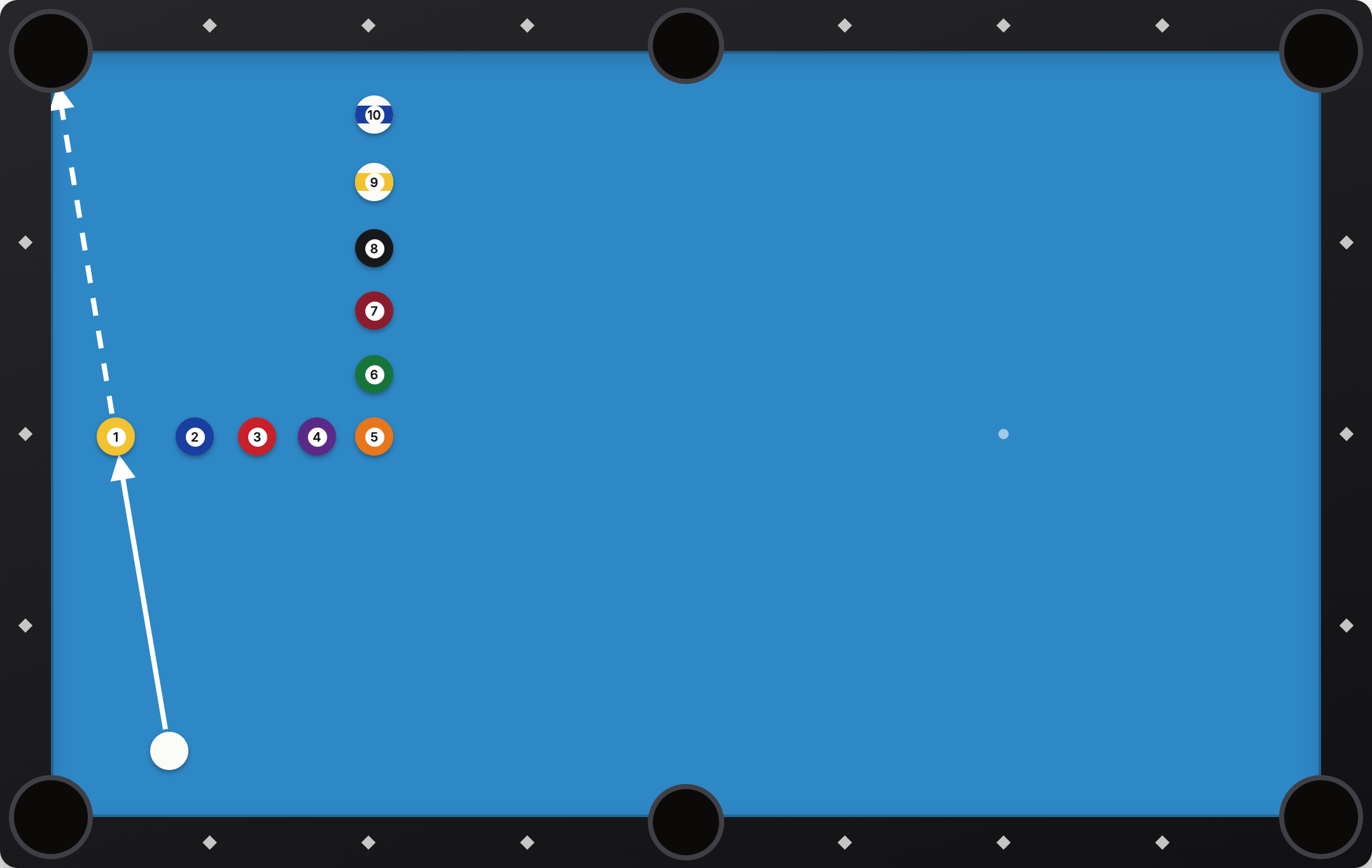
This is the foundation. Place the 8 ball on the spot near the top of the table and put the cue ball on the baulk line in a straight line behind it, aiming at the top corner pocket. The shot is a long, dead straight pot with no angle to hide behind.
How to run it
- Pot the ball and bring the cue ball back off the top cushion as straight as you can.
- Play ten in a row and record two numbers: pots made, and how many times the cue ball came back within a ball width of your cue tip line.
- Stop after ten. Do not chase a better score with a tired arm, because you will only groove the error.
What to watch
The cue ball return line tells you more than the pot does. A ball that drops but sends the cue ball back a foot to the left means you hit the object ball off centre and got lucky with the pocket. On a heyball table that luck runs out quickly. Chase the straight return and the pots follow.
Drill 2: the pocket jaw test
Rounded pockets are the single biggest shock for a player arriving from pool, so train for them directly. Place an object ball about a foot from a corner pocket and slightly off the cushion, then pot it from six different cue ball positions fanned around the table, from almost straight to a thin cut of around sixty degrees.
Play each position three times. Keep a simple tally for each angle so you can see where your potting falls off a cliff. Almost every player has a blind side, usually the thin cut from the same side as their bridge hand, and the only way to find it is to count.
Why this one matters most
In heyball, the cut angle at which a pocket stops accepting a ball is far shallower than in 8 ball on a bar table. If you know your limit is around fifty degrees on the left side, you stop gambling on the shot and start playing the safety or the two way shot instead. That single piece of self knowledge is worth more than another hour of random potting.
Drill 3: balls on and near the cushion
Heyball racks break into clusters along the rails more often than pool racks do, so cushion play is not an edge case. It is most of the game.
Set three balls frozen on the long cushion, spaced evenly along it, and pot each one into the far corner. Then move them a quarter of a ball off the cushion and repeat. The two situations need different aiming: a frozen ball demands you strike the object ball and cushion almost simultaneously, while a ball sitting slightly off the rail gives you a true contact point but punishes any swerve.
- Round one: three frozen balls, three attempts each, record the total.
- Round two: same three positions a quarter ball off the rail.
- Round three: alternate between the two so you have to reset your aim every shot.
Round three is the one that transfers to a match, because in a real frame you never get three identical shots in a row.
Drill 4: pace control on fast cloth
Worsted cloth is why so many newcomers to heyball end up stuck on the wrong side of the table. The fix is a drill with no potting in it at all.
Put the cue ball on the baulk line and play it up and down the table with no object ball. Your target is to stop it in a defined zone: first the far third of the table, then the middle third, then back in baulk after two cushions. Play five of each and score a point only when the ball finishes inside the zone.
Then add the ball back in. Pot a straight ball and stop the cue ball dead in a one foot circle behind it, then do the same but finish two feet past it, then four feet. Pace is a skill you can measure, and measuring it is how it improves.
Drill 5: the break and the first ball
A heyball rack rewards a break that spreads the pack and leaves a pottable ball, and it punishes a break that scatters balls to the rails with the cue ball marooned. Rack up, break, and before you touch another ball write down three things:
- How many balls finished within a ball width of a cushion.
- Whether you have a clear pot, a half chance, or nothing.
- Where the cue ball finished.
Do that ten times with the same break, then change one variable, usually cue ball position or pace, and do ten more. After twenty breaks you will have a far better idea of your own best break than any video can give you, because the numbers come from your stroke on your table.
Drill 6: run the group
Finish every session with something that looks like a frame. Spread seven balls of one group plus the 8 ball across the table by hand, in positions that are awkward but all pottable, and try to clear them in order of your choosing. Give yourself one life: a single miss ends the attempt.
Record the highest number of balls you reach. This is the closest thing to a match score you can generate alone, and because the balls are placed by hand you can steadily make the layouts harder as your clearance count climbs. Players who came up through pool will recognise the logic from the pool position play drills that build toward running racks, and the same idea holds here with tighter margins.
How to build a week around these drills
Six drills is too many for one session. A week that actually produces change looks closer to this:
- Session one, cue action: drill 1 and drill 4, around forty minutes.
- Session two, potting limits: drill 2 and drill 3, around forty five minutes.
- Session three, frame play: drill 5 and drill 6, as long as your concentration holds.
Write the scores down every time. Not in your head, on paper or in an app. The whole value of a drill is the comparison between this week and last week, and memory is a generous liar about how many balls you potted. If you track your sessions and your matches in CuePal, you can log drill results alongside your verified match results and see whether the practice is actually moving your game.
If you run a club
Drills like these spread through a venue when someone gives them structure. Clubs that put a weekly practice slot on the calendar, post a leaderboard for the drill 6 clearance count, and let members book a table for it tend to see the same players coming back, whether the venue runs heyball, pool, snooker, or all three under one roof. That is a scheduling and membership job as much as a coaching one, and it is the kind of thing club management software is there to carry.
Start with one number
If you take one thing from this list, take drill 2. Spend twenty minutes finding the cut angle at which your potting collapses, write the number down, and play the next month knowing it. Heyball is a game of tight margins, and the players who improve fastest are not the ones who pot the most balls in practice. They are the ones who know exactly which balls they can pot.
Similar Articles

Join The Biggest Snooker Community
Discover events, meet players, and level up your game.

