
.png)
How to Run Open Play Sessions at Your Snooker Club
Walk into most clubs on a quiet weeknight and you will see the same picture: a few regulars on one table, a newer member practising alone, and several tables sitting empty. The players are there, or could be, but nothing brings them together. Well run open play sessions fix that. They give every member a reason to turn up, a guaranteed game against someone at their level, and a night on the calendar they can build their week around.
This guide explains what open play is, how to design sessions that feel fair and fun, which rotation formats work best, and how to run it all without a clipboard, a whiteboard and a stack of loose scorecards.
What open play sessions are and why they matter
Open play is structured casual play. Instead of members turning up and hoping someone is free, the club sets a time, a group of tables and a format. Players register, get matched against opponents of a similar standard, and rotate through short matches over the session.
It sits between a casual knock and a competitive event. There is no draw to survive and no season to commit to, but every frame still counts for something. That balance is exactly why it works so well as a weekly anchor.
- Nobody is left without a game: newer members no longer have to find a partner or feel awkward asking a stronger player.
- Predictable table usage: you know in advance which tables are busy and for how long.
- Lower barrier than a tournament: players who would never enter a knockout will happily sign up for a relaxed evening of frames.
- Community: rotating opponents means members meet people they would never have played otherwise.
We describe open play as the most powerful retention tool available to club operators in our article on the 4 pillars of growth for billiard and snooker clubs. It is often the first event a new member attends, and the one that turns them into a regular.
Designing open play sessions members want to attend
A good session feels effortless to players, but it rests on a handful of decisions you make in advance. Get these right once and every week becomes easy to repeat.
Group players by ability
The single biggest reason casual players stop coming is being consistently outmatched. Label each session with a clear standard, such as Beginner, Intermediate or Advanced, or use a rating band if your club has one. A fair rating based on real results makes this much easier, which is why many clubs pair open play with live snooker rankings for amateurs.
Set the group size and tables
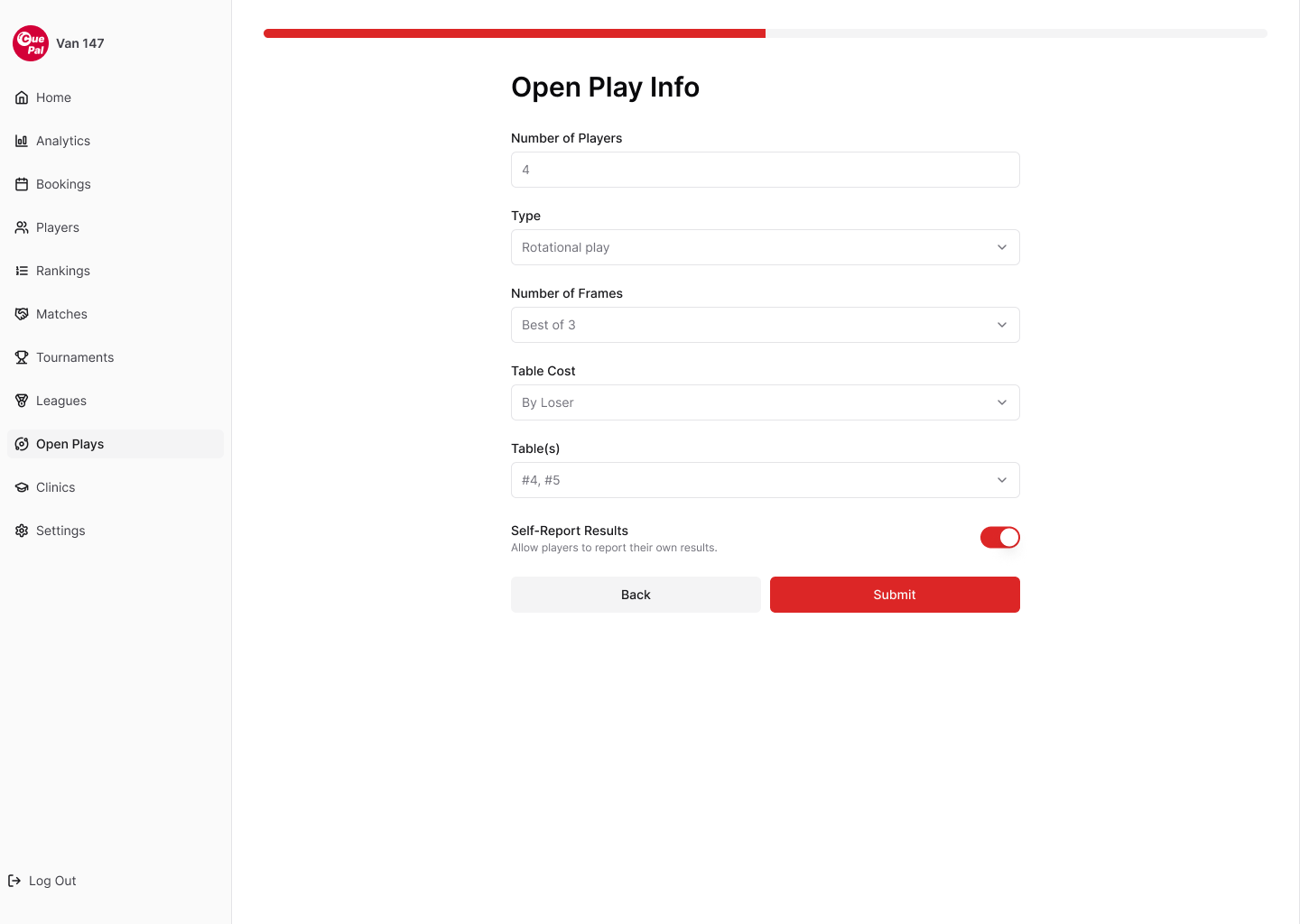
Match the number of players to the tables you can give up. Four players on two tables is a comfortable starting point: two matches run at once and everyone plays every opponent within the evening. Six or eight players across three or four tables creates a livelier atmosphere once the session is established.
Choose a short match length
Keep matches short so players rotate often. Best of 3 is the sweet spot for most clubs. Single frames suit very large groups or short time windows, while best of 5 works for advanced sessions where players want longer contests.
Decide how table time is paid for
Money is where casual play gets awkward, so settle it upfront. Common options are a flat entry fee per player, splitting the table cost evenly, or the loser pays the table, which adds a little friendly edge to every frame. Whatever you choose, publish it with the session details so nobody argues at the table.
Rotation formats that keep tables moving
The rotation is what makes open play feel different from a casual evening. Pick one format and use it consistently so players know what to expect.
Rotational play
In rotational play, every player meets every other player in the group over the session, like a mini round robin. With four players, each person plays three matches, and six matches in total fit comfortably into a two hour slot on two tables. It is simple, fair and easy to explain.
Winner stays on
The winner keeps the table and the next player in the queue steps up. It is fun and fast, but weaker players can spend long spells waiting, so it works best in sessions where standards are very close.
Timed rounds
Every match runs for a fixed time, then everyone moves on. Timed rounds keep the evening perfectly on schedule and suit busy clubs where tables are booked straight after the session.
Quick rotation checklist
- How many tables can you give the session, and for how long?
- How many matches should each player get in that window?
- Are standards close enough for winner stays on, or is full rotation fairer?
- Who records the results: a host, or the players themselves?
Running the night smoothly
On the evening itself, your aim is to keep every table busy and every player informed.
- Open registration early: let players sign up in advance so you know the numbers and can cap the group.
- Keep a waiting list: late withdrawals are normal, and a reserve keeps the rotation balanced.
- Record every result: frames won and the highest break give players something to talk about and build a history over time.
- Let players self report: for relaxed sessions, trusting players to enter their own scores frees the host to welcome newcomers.
- End on time: a session that finishes when promised is one people book again.
Consistency matters more than anything else. The same night, the same time, every week. Once members know that Monday is open play night, attendance starts to look after itself.
Why whiteboards and group chats hold open play back
Many clubs start open play with a whiteboard behind the bar and a messaging group. It works for a couple of weeks, then familiar problems appear:
- Sign ups scattered across messages, phone calls and names shouted across the room.
- Rotations worked out by hand every time someone arrives late or leaves early.
- Results wiped off the board at the end of the night, so there is no record of who played whom.
- Table fees chased in cash after players have already gone home.
- No way to spot drop offs, so you only notice a regular has stopped coming weeks later.
The host ends up managing admin instead of the atmosphere, and the session quietly loses momentum.
How CuePal helps you run open play sessions
Purpose built snooker club management software takes the repetitive work out of open play. CuePal includes a structured open play system that lets clubs host skill matched sessions that keep tables busy, attract players of all levels and build community through regular, accessible play. Formats, rotations and results are tracked automatically.
What that looks like in practice
- Session setup in a few clicks: choose the number of players, the format, the number of frames, how table cost is handled and which tables to use.
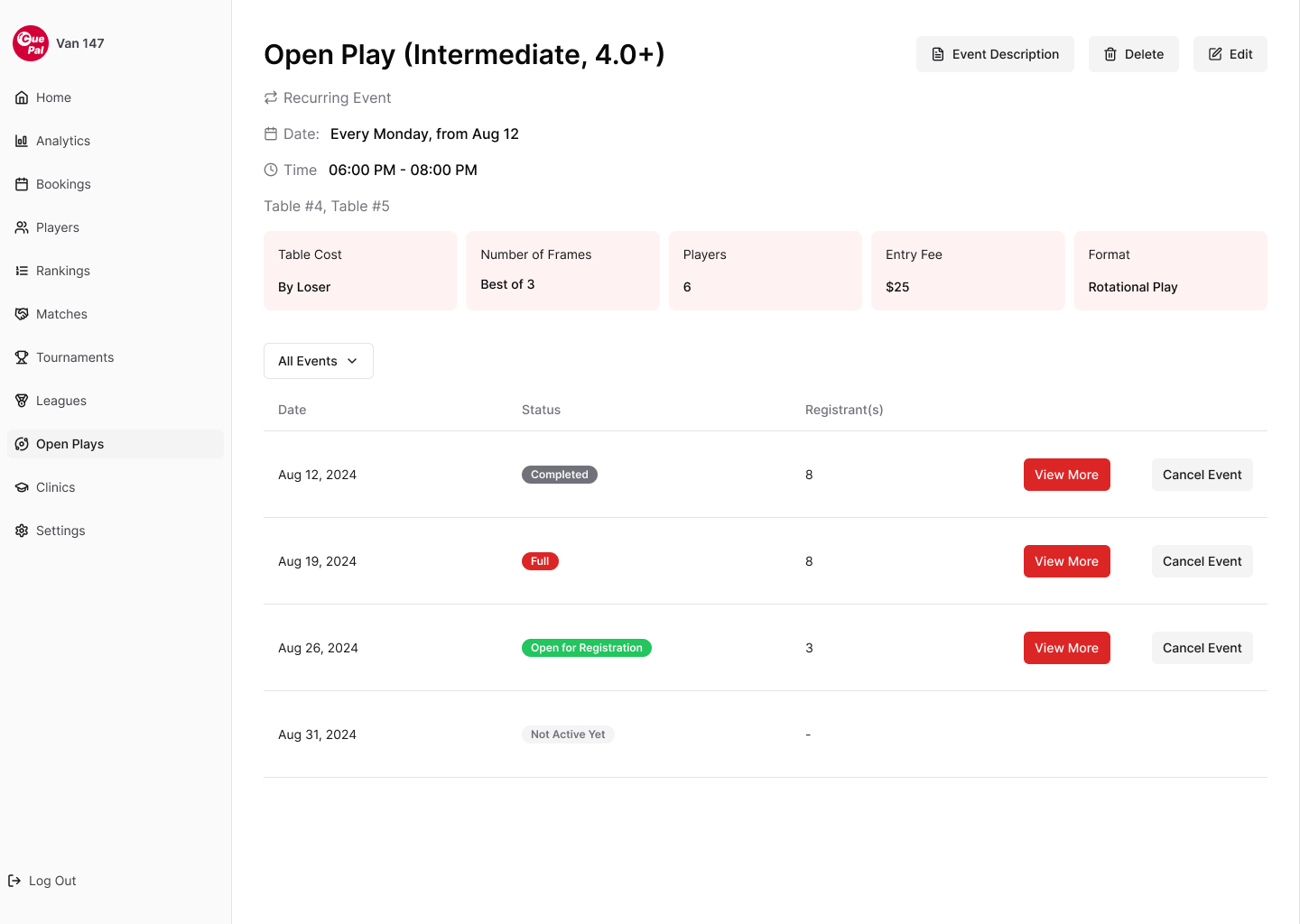
- Recurring sessions: set a weekly open play once and each date appears with its own registration status.
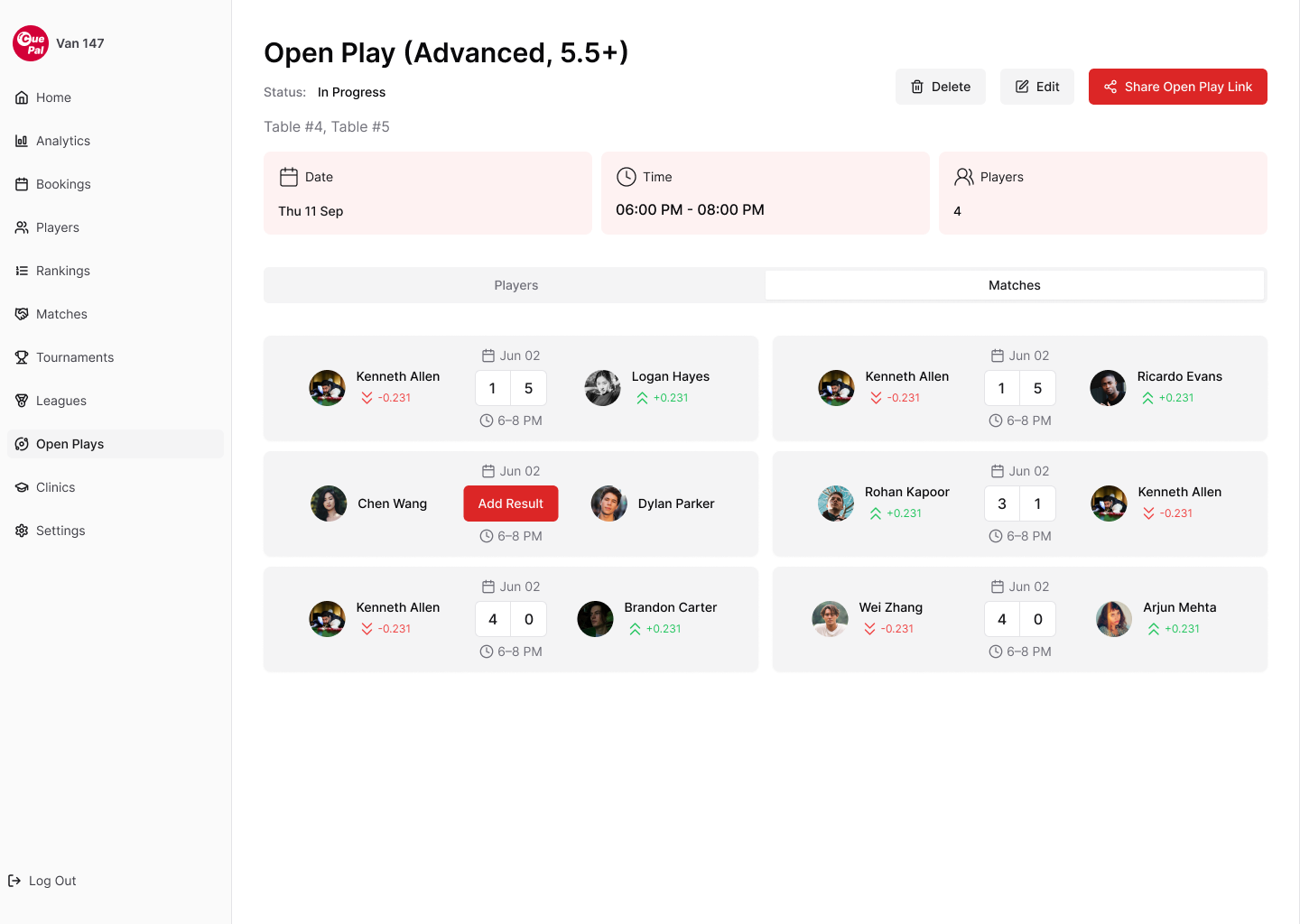
- Match tracking: every pairing in the rotation is listed, with results entered as frames won and highest break.
- Self reported results: optionally allow players to enter their own scores.
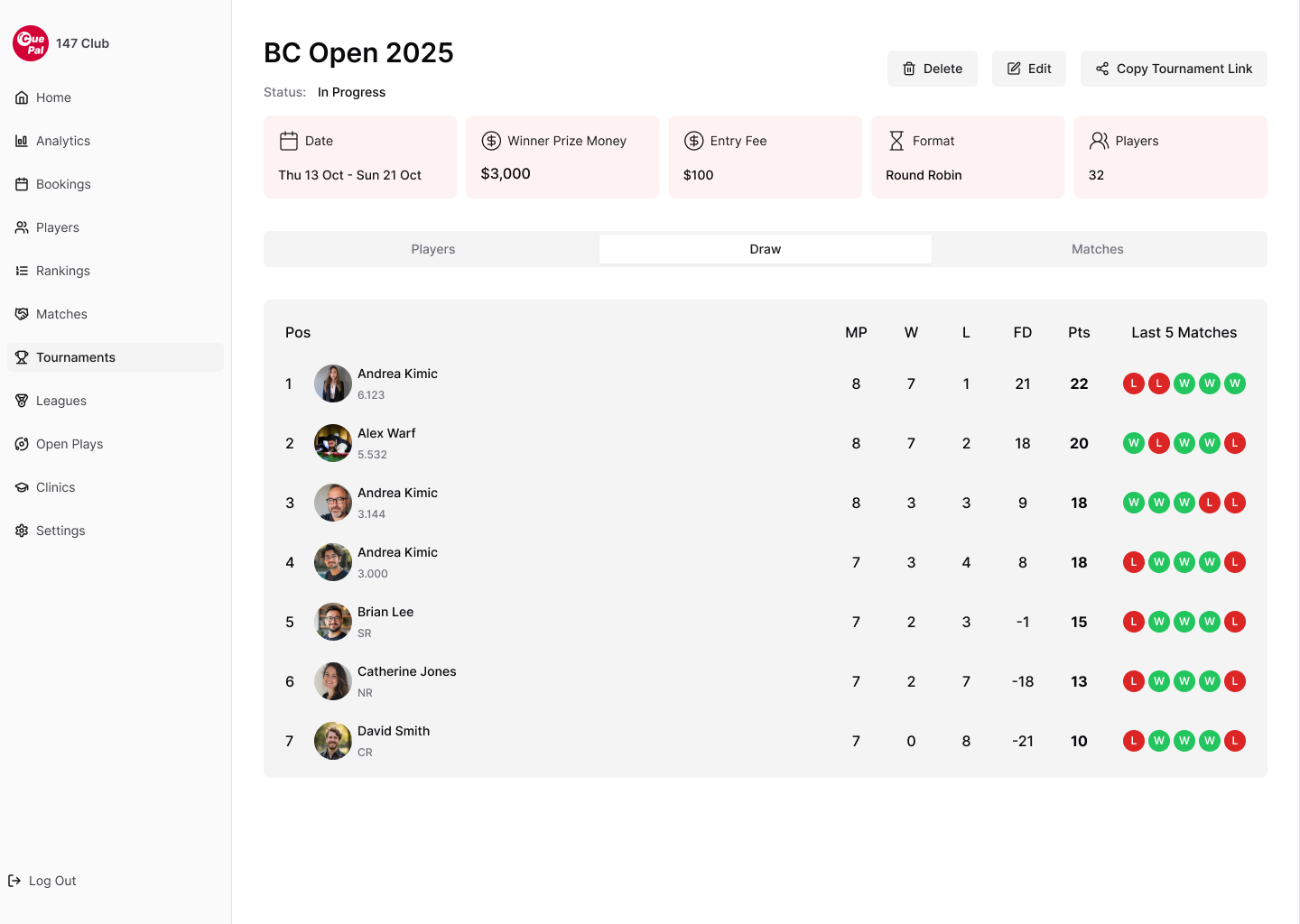
- Club rankings: CuePal automatically ranks players based on verified results and performance trends, so casual frames still feed a fair picture of form.
- Player mobile app: members see live results, personal stats, upcoming matches and club notifications on iOS and Android.
Which plan fits your open play calendar
According to the CuePal pricing page:
- Free: $0, up to 10 members and 1 open play per week, plus 1 tournament per month.
- Silver: $45 per month or $490 per year, up to 20 members and 2 open plays per week, plus tournaments, a quarterly league, a monthly clinic, online booking and online payments.
- Gold: $95 per month or $995 per year, unlimited members and unlimited events, plus analytics covering retention, engagement, churned players and club performance.
A single weekly session is a great way to start on the Free plan. If you want separate beginner and advanced nights, Silver covers two sessions a week, and Gold removes the limits for clubs that run open play most evenings. Once your open play nights are established, a club tournament is a natural next step, and our guide on how to run a snooker tournament with automatic brackets shows how.
The best open play night is the one where every player gets a fair game, nobody waits too long and everyone already knows they are coming back next week.
Conclusion
Open play sessions are the simplest way to turn empty weeknight tables into a regular, social, well attended event. Group players by ability, keep matches short, pick a clear rotation, settle table costs upfront and run it on the same night every week. Let software handle the sign ups, the rotations and the results, and you can spend the evening building the atmosphere that keeps members loyal.
Ready to launch your first session? Create your club on CuePal for free, or book a demo to see how open play works for your club.
Similar Articles
Join The Biggest Snooker Community
Discover events, meet players, and level up your game.